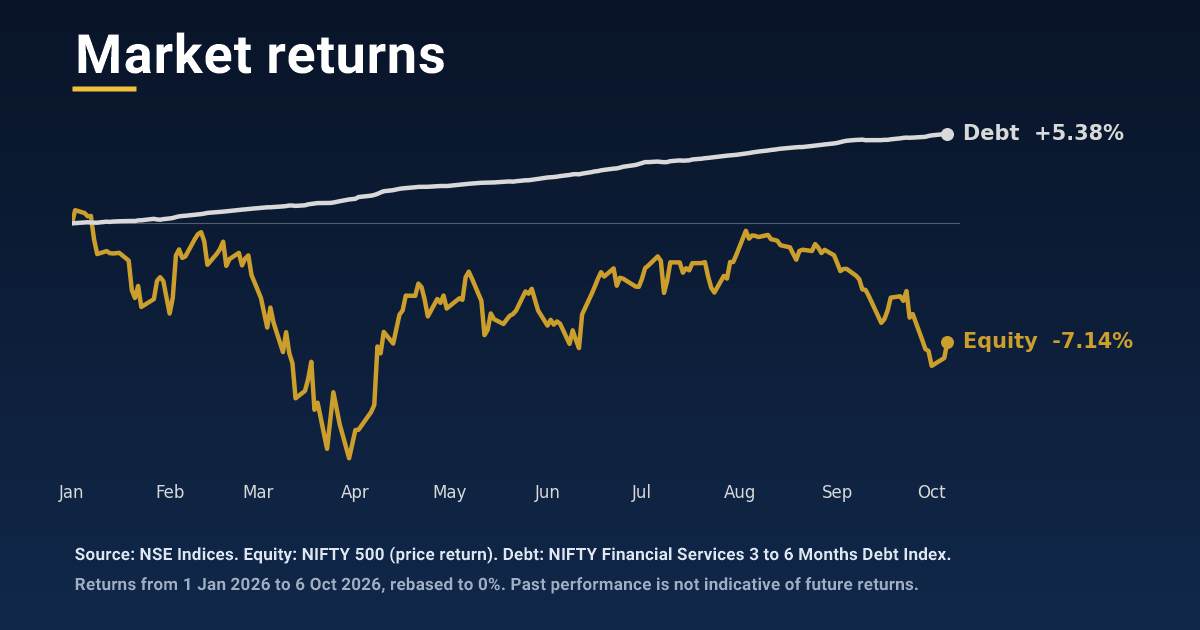
If you opened your investment app this week and felt your stomach drop, you are in good company.
The Nifty 50 has now fallen for eight weeks in a row. On 1 October 2026, it touched a six-month low. As of 18 September, it was about 13.4% below its September 2024 peak. Foreign investors pulled more than Rs 36,000 crore out of Indian shares in September alone. Crude oil is hovering near $107 a barrel, and the rupee has slipped to record lows against the US dollar, at one point near 96.76.
When the news looks like this, one question comes up again and again: is there a calmer place for my money?
For many people, the answer they hear is “debt funds”. That answer is partly right and partly incomplete. In this blog, we will go through the whole picture.
What Is a Debt Fund?
Think of a debt fund as a lender, not an owner.
When you buy an equity fund, your money buys small pieces of companies. If the companies grow and earn more, your investment can grow with them. If investors panic, the prices of those pieces fall, sometimes sharply, even when the companies themselves are fine.
When you buy a debt fund, your money is lent out. The fund manager lends to the government, to banks and to companies by buying their bonds, treasury bills, commercial paper and similar instruments. Each of these is a written promise: “We will pay you interest at regular intervals, and return your money on a fixed date.”
So an equity fund depends on how companies perform and how investors feel. A debt fund depends mainly on interest and on whether borrowers repay. That difference is the whole reason the two behave differently, and it is also why one is not simply a “safer version” of the other.
Why Debt Funds Often Stay Calm When Shares Fall?
Share prices swing with news, fear and greed. They can change by the minute. Bond interest does not work that way. A bond pays its promised interest whether the stock market is up or down, and a fund holding hundreds of bonds keeps earning that interest every single day. The fund’s price, called the NAV (net asset value), rises a little each day as this interest builds up. This steady build-up acts like a cushion.
That is why the chart of a short-term debt fund often looks like a gentle upward slope, even in weeks when an equity chart looks like a roller coaster.
There is a second reason. Shares and bonds respond to different forces. Shares respond to company profits and investor mood. Bonds respond to interest rates and to the ability of borrowers to repay. Since these forces are not the same, the two assets do not always move together. When equity is nervous, money often looks for safer places, which can support bond prices as well.
The Main Risk: When Interest Rates Rise
Imagine you own a bond that pays 7% interest. Next month, the market changes and new bonds start paying 7.5%. Now nobody wants to pay full price for your 7% bond when a 7.5% bond is available. So the market price of your bond falls until its overall return becomes competitive. This is interest-rate risk: when rates rise, existing bond prices fall.
How big is the fall? It depends on how many years the bond has left to run. A bond maturing in three months barely moves, because you will get your money back very soon and can reinvest at the new higher rate. A bond maturing in ten years can fall noticeably, because you are stuck with the lower rate for a long time.
Fund managers use a measure called duration to describe this. You can think of duration as roughly “how sensitive is this fund to a change in interest rates?” As a rough rule of thumb, if a fund has a duration of 5 years and interest rates rise by 1 percentage point, the value of the bonds may fall by about 5%, before counting the interest the fund keeps earning. If a fund has a duration of 0.5 years, the same rise would cut the value by only about 0.5%.
This is no longer just theory. On 7 October 2026, the RBI raised the repo rate by 25 basis points, from 5.25% to 5.50%. It was the first rate hike since February 2023, the decision was unanimous, and the RBI changed its policy stance to “calibrated tightening”. The RBI also signalled that rate cuts are off the table in the near term, and that its next move can only be a hike or a pause. On the same day, the 10-year government bond yield rose to as high as 7.27%, up from 7.19% at the previous close. In simple terms, this is interest-rate risk playing out in real time: funds holding longer-term bonds can see their NAV dip when yields rise, while short-duration funds feel it far less.
The Main Types of Debt Funds
India’s market regulator, SEBI, groups debt funds into fixed categories, so the name of a category tells you a lot about what to expect. Here are the ones most useful for a retail investor, from the shortest to the longest.
- Liquid funds: Invest in instruments maturing within about 91 days, ideal for emergency money or cash waiting to be invested.
- Short-duration funds: Hold bonds maturing in roughly one to three years, and suit goals that are two to three years away.
- Corporate bond funds: Put at least 80% of their money in the highest-rated company bonds, aiming for slightly better returns with high credit quality.
- Gilt funds: Invest at least 80% in government securities, with almost no credit risk but high interest-rate risk in long-maturity funds.
- Dynamic bond and long-duration funds: Stretch or change maturity to gain when rates fall, and can lose when rates rise.
- Target-maturity funds: Hold bonds maturing around a fixed date, so returns are more predictable if you stay until then.
- Credit risk funds: Hold lower-rated bonds for higher yield, and carry the highest credit risk in the debt family.
How to Choose: Match the Fund to Your Timeline
The simplest rule is also the best one: the sooner you need the money, the shorter the duration you should choose.
Also, choose a shorter duration if you expect interest rates to rise.
What It Costs, and How It Is Taxed
Every mutual fund charges an annual fee called the expense ratio. It is deducted from the fund’s value daily, so you never see a bill. In debt funds, where returns are modest, a high fee can swallow a big share of your gain.
Some funds also charge a small exit load if you withdraw within a set period. Liquid funds, for instance, often use a small graded load for the first few days. Exit loads differ by scheme, so always read the scheme document.
On tax: for debt fund units bought on or after 1 April 2023, gains are taxed at your income-tax slab rate, however long you hold. Switching from one fund to another counts as a sale, so it can trigger tax too. NRIs follow different tax-deduction rules, so please confirm the current position with a qualified advisor.
Using Debt to Take Part in the Recovery: Rebalancing and STPs
There is a practical way debt funds can help even when you want equity exposure. It is called rebalancing, and there are a few simple tools for it.
- Rebalancing: This means bringing your portfolio back to your chosen mix of equity and debt, so that a market fall does not leave you with a split you never planned. When equity falls, you move a little from debt into equity at lower prices, and when it rises, you do the opposite, by rule and not by emotion.
- STP (Systematic Transfer Plan): This moves a fixed amount from one fund to another at regular intervals, for example Rs 20,000 a month from a liquid fund into an equity fund. It is a way to enter the market gradually if you have a large sum and feel nervous about investing it all at once.
An illustration: suppose you have Rs 6 lakh that you wish to move into equity over time, but you do not want to do it all today. You could park it in a liquid fund and set an STP of Rs 1 lakh a month for six months. If prices fall further, your later instalments buy more units. If prices rise, you have already invested part of it. You cannot know which will happen, and that is precisely the point of spreading it out.
- SWP (Systematic Withdrawal Plan): This does the reverse. It withdraws a fixed amount regularly from a fund, which is useful for a regular income from a debt fund while the rest stays invested.
Two cautions. First, every switch or transfer is a sale of the first fund, so check the exit load and the tax before you move money. Second, rebalancing and STPs are tools for discipline, not for timing. They do not guarantee a better outcome, but they reduce the pressure of guessing the bottom.
A Falling Market Is a Chance to Build a Better Plan
Falling markets hurt, but they also reward discipline. Lower prices mean a SIP buys more units for the same amount. A portion of your money in debt funds means you will not have to sell equity at a low to meet a bill. And the habit of giving every rupee a job and a deadline will serve you in every market, up or down.
So the real question is not “equity or debt?” It is “What is this money for, and when will I need it?” Once you can answer that, choosing a fund becomes much easier. A good plan cannot guarantee returns, but it does give you the best chance of staying invested long enough for markets to do their work.
"Mutual fund investments are subject to market risks. Please read all scheme-related documents carefully. Past performance is not indicative of future returns. This content is for educational purposes only and is not investment advice."